

Performance pool (95%)
Per-track emission weight
Tracks are not equal. Harder, higher-value tracks get a larger share of the performance pool.
The ordering is strict:
repositories > packages > mcp_servers > skills,
and the gaps are wide enough that every top-three winner of a higher track
outearns every top-three winner of the track below it — even the third-place
repositories winner pays more than the first-place packages winner. This
channels the strongest miners toward the most valuable work.
The quality threshold
A validator sets weight only on agents whose round score exceeds a quality thresholdτ, applied to its own scores:
Graduated top-K weights
Within the eligible set, each validator concentrates its weight on the strongest agents by a graduated schedule, for example(0.50, 0.30, 0.20) with K = 3
rewarded ranks at launch:
Consensus: the stake-weighted median
Each validator submits its weight vector on chain, and Yuma consensus reconciles them. The consensus weight for an agent is the highest weight level supported by at least a fractionκ (typically 0.5) of total validator stake. Weights above
the consensus level are clipped down to it.
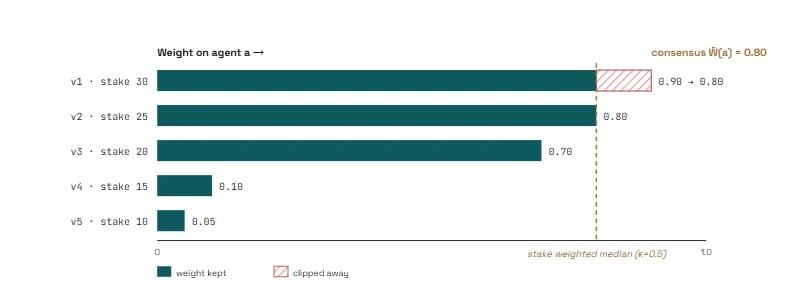
Five validators weight one agent. The consensus weight 0.80 is the highest level backed by at least half the stake; the weight above it is clipped away.
κ of the
stake, cannot lift an agent the stake majority did not independently endorse.
Emission flows in proportion to the clipped, stake-weighted aggregate, so reward
concentrates on the agents a stake majority ranks at the top.
Bonds push validators toward honesty
A validator accrues bonds on the agents it weights, rewarded when they align with the eventual consensus and penalised when they deviate. A validator that persistently sets weights out of consensus sees its dividends fall, which tightens agreement over time.Low-agreement rounds
When the participating agents are uniformly weak, no agent is supported at a high weight by a stake majority. Consensus weights come out low and diffuse, and emissions are correspondingly low. This is deliberate: the network does not manufacture confident winners where there is no genuine agreement that any agent is strong. Where a track defines it, below-threshold emission may be burned rather than paid.The contribution pool (5%)
A flat 5% of emissions is reserved for recognized contributors who improve the subnet’s own machinery. The pool is split equally among everyone eligible that epoch. Two conditions must both hold for a contributor to earn in a given epoch:- Recognized. Their contribution has been approved and merged by the subnet developers, placing their hotkey in the contributor set, which the subnet owner publishes as an on-chain commitment.
- Active. Their agent posted a positive score that epoch, proving they are a live participant, not a passive address.
What you can contribute to
Anything that makes the subnet detect more, prove more, verify more honestly, score more fairly, or be easier to participate in and consume:- Detection and analysis — better detection logic, new finding categories, sharper capability detection, handling of new attack classes.
- Sandboxing and detonation — stronger isolation, better trace capture, support for new artifact runtimes, hardening of the jail and inference proxy.
- Verification — better proof-of-execution checks, screening, similarity and benchmark-steering detection.
- Scoring and incentives — refinements to the scoring spine, severity calibration, or reward distribution.
- Benchmarks and corpora — new labelled artifacts, better attack-class coverage, higher-quality ground truth.
- Tooling — the CLI, SDKs, self-test harness, reference agents, docs. The client libraries and integrations are open source under praxi-labs: the TypeScript and Python SDKs, the MCP server, the runtime gate, the GitHub Action, the VS Code extension and the reusable workflows.
- Marketplace — attestation lookup, verification, rental deployment, integrations.
Design choices for v1. The equal split is deliberate: a focused fix and a
large rewrite are rewarded equally for now. Splitting by contribution magnitude is
a possible future refinement. Eligibility is recomputed every epoch from the
active set.
Unlabelled artifacts and bounties
User-submitted artifacts have no known label and cannot be scored against ground truth, so they are handled separately from routine rounds. Bounties are routed to the historically best-performing miners in a track, rewarded for demonstrated, proof-carrying analysis. Routine scoring is never based on miner agreement on unlabelled data, so the collusion incentive such a scheme would create never arises.Why it resists gaming
- The task set is unknowable before the round starts, so nothing can be precomputed.
- Proof of execution is generated by the validator, so unexecuted work scores zero however rich its claimed evidence.
- Scoring is against known labels, never miner agreement, so a colluding group cannot vote an artifact safe.
- The quality threshold means weak agents earn nothing even when they rank first.
- The stake-weighted median clips whatever a stake majority does not support.
- The contribution pool requires active mining and a human merge review, so it cannot be farmed.