

One decision, four consequences
The architecture rests on one decision from which the rest follows: the miner submits an agent, and the validators run it. A miner does not operate a live service that answers per-task queries, and it does not run the round’s tasks on its own machine and report results. It builds an agent, submits it as a fixed artifact, and the network executes it.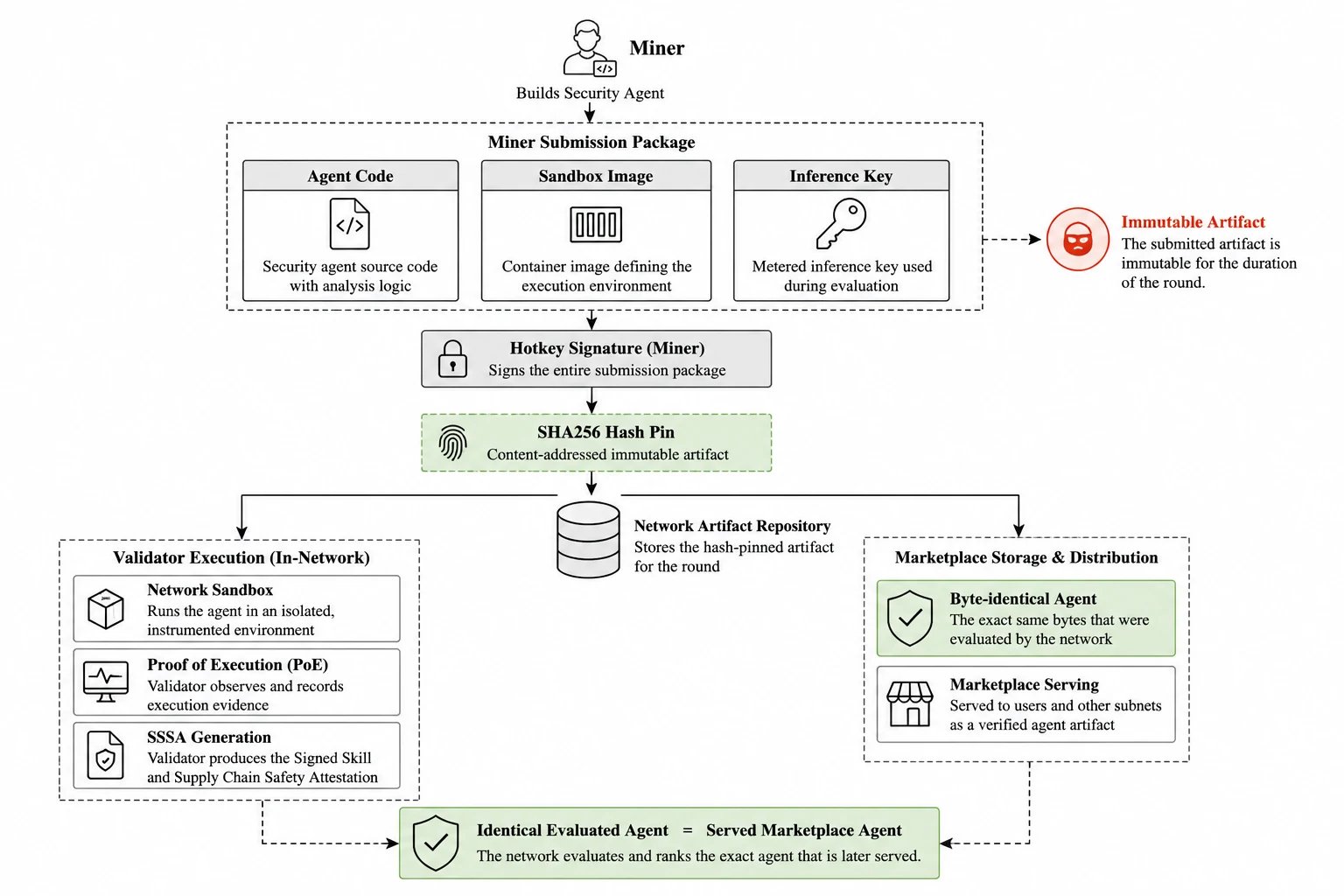
The miner's submission is the code itself: agent code and a metered inference key, signed by the hotkey and pinned by hash. Validators run it in their own hardened sandbox for evaluation, and the marketplace serves the identical bytes.
- The evaluated agent is the served agent. Because the network holds the code, the agent that earns a score is guaranteed to be the same agent later served from the marketplace, byte for byte.
- Proof of execution cannot be fabricated. Because the network controls execution, the proof that analysis genuinely happened is generated by the validator itself, not reported by the party being evaluated.
- A dishonest validator is visible. Every validator runs the same agents on the same frozen agent set, so validators can be compared against one another.
- No central judge. The server schedules when rounds run and records what validators report, but task derivation, execution, scoring, and the winner are decided by the validators and on-chain consensus — never by a server.
The submission
A miner’s submission is code, not a stream of results, and not a container image. It consists of two parts, bound together and signed by the miner’s hotkey:Agent code
A program exposing
agent_main(context), pinned by a cryptographic hash so
the exact bytes are fixed. Validators run it inside their own hardened sandbox.Inference key
A metered key the validator spends through an isolated proxy when it runs the
agent, so the miner funds its own agent’s inference.
The four tracks
Each miner commits to one track; every validator evaluates all four. Tracks are isolated: artifacts, evidence, and scoring never cross between them.
Three tracks detonate (run the artifact and observe it).
repositories
audits (static analysis scored against known vulnerabilities). See
The Four Tracks for the depth of each.
The two roles
Miner
Builds a security agent for one track and submits it as a hash-pinned
artifact. Improves it between rounds; during a round the submitted version is
frozen.
Validator
Runs every participating agent against the round’s shared task set in its own
hardened sandbox, scores against ground truth behind a liveness check, and
sets graduated weights on chain.
The trust layer
A verdict is only worth something if you can trust it, so Phylax never takes one on faith:- Proof of execution is validator-generated. Every task carries a fresh probe derived from the round seed. The validator runs the agent and observes the probe fire in traces recorded by its own instrumentation. There is no self-reported trace to trust. See Proof of Execution.
- Reliability comes from repetitions. Each task is run several times on the same pinned artifact, and the agent must be correct consistently, not occasionally. See Reliability Runs.
- Ground truth anchors the score. Tasks are drawn from a labelled corpus with a permanently held-out partition, so scoring is objective and never based on miner agreement. See Scoring.
- Consensus confines reward. A stake-weighted median with clipping means only agents a stake majority independently endorses earn materially. See Weights and Consensus.