

The quality threshold
A validator sets weight only on agents whose round score exceeds a quality thresholdτ:
Graduated weights on the top performers
Within the eligible set, the validator concentrates its weight on the strongest agents by a graduated schedule, most to the first, less to the second, less to the third, and zero below:The stake-weighted median and clipping
If the chain simply summed validators’ weights, every validator’s private picks would be rewarded. Yuma does not sum. For each agent, the consensus weight is the highest weight level supported by at least a fractionκ (typically 0.5) of
total validator stake, and weights above it are clipped down to it.
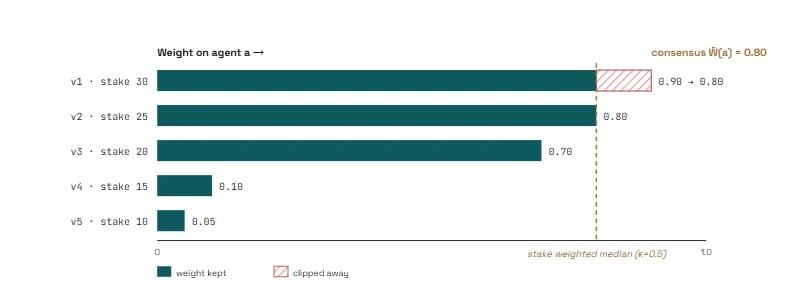
Five validators weight one agent. The consensus weight 0.80 is the highest level backed by at least half the stake; v1's weight above it is clipped away.
κ, the consensus weight would collapse toward zero,
and the outlier weight would be clipped away entirely. A single validator, or any
group holding less than κ of the stake, cannot reward an agent the stake
majority did not independently endorse.
Miner emissions are then allocated in proportion to the clipped, stake-weighted
aggregate, which under the graduated schedule concentrates emission on the agents
a stake majority independently ranks at the top.
Validator bonds
A validator accrues bonds on the agents it weights, rewarded when they align with the eventual consensus and penalised when they deviate, through an exponentially smoothed process. A validator that persistently sets weights out of consensus, whether by error or manipulation, sees its bond value and thus its dividends fall. The standing effect is to push validators toward consistent, honest evaluations.The honest majority assumption
These guarantees hold when the majority of validator stake is honest. A colluding group holding more thanκ of stake could in principle move the consensus, so
the security of the mechanism rests on a healthy validator set: enough
independent validators, with stake distributed widely enough that no small group
controls a majority. This is a standing operational requirement of the network.