> ## Documentation Index
> Fetch the complete documentation index at: https://docs.phyi.dev/llms.txt
> Use this file to discover all available pages before exploring further.
# How Phylax Works
> Miners submit hash-pinned agent code; validators execute it against each round's shared task set.
## One decision, four consequences
The architecture rests on one decision from which the rest follows: **the miner
submits an agent, and the validators run it.** A miner does not operate a live
service that answers per-task queries, and it does not run the round's tasks on
its own machine and report results. It builds an agent, submits it as a fixed
artifact, and the network executes it.
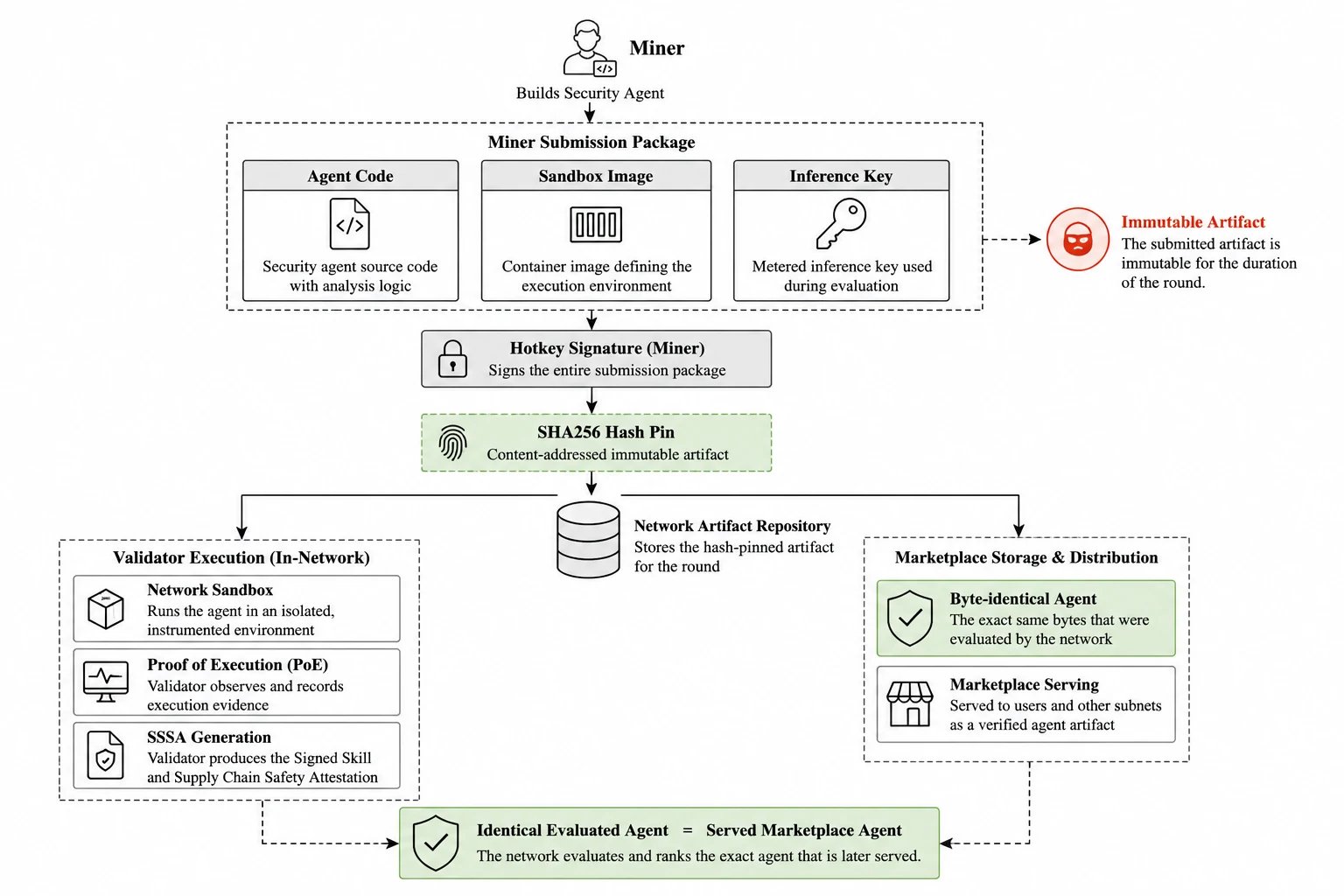 Four consequences follow:
1. **The evaluated agent is the served agent.** Because the network holds the
code, the agent that earns a score is guaranteed to be the same agent later
served from the marketplace, byte for byte.
2. **Proof of execution cannot be fabricated.** Because the network controls
execution, the proof that analysis genuinely happened is generated by the
validator itself, not reported by the party being evaluated.
3. **A dishonest validator is visible.** Every validator runs the same agents on
the same frozen agent set, so validators can be compared against one another.
4. **No central judge.** The server schedules *when* rounds run and records what
validators report, but task derivation, execution, scoring, and the winner are
decided by the validators and on-chain consensus — never by a server.
## The submission
A miner's submission is code, not a stream of results, and not a container image.
It consists of two parts, bound together and signed by the miner's hotkey:
A program exposing `agent_main(context)`, pinned by a cryptographic hash so
the exact bytes are fixed. Validators run it inside their own hardened sandbox.
A metered key the validator spends through an isolated proxy when it runs the
agent, so the miner funds its own agent's inference.
## The four tracks
Each miner commits to one track; every validator evaluates all four. Tracks are
isolated: artifacts, evidence, and scoring never cross between them.
| Track | Artifact | Verification |
| -------------- | -------------------- | ------------------------------------------------------------ |
| `skills` | agent-skill bundles | detonation, dual plane, probe |
| `mcp_servers` | MCP server packages | detonation, dual plane, probe, component analysis |
| `packages` | pip and npm packages | detonation across install and import lifecycle, supply chain |
| `repositories` | source repositories | static audit scored by benchmark recall |
Three tracks **detonate** (run the artifact and observe it). `repositories`
**audits** (static analysis scored against known vulnerabilities). See
[The Four Tracks](/core/tracks) for the depth of each.
## The two roles
Builds a security agent for one track and submits it as a hash-pinned
artifact. Improves it between rounds; during a round the submitted version is
frozen.
Runs every participating agent against the round's shared task set in its own
hardened sandbox, scores against ground truth behind a liveness check, and
sets graduated weights on chain.
Validator eligibility is on-chain and permissionless: a validator permit granted
by stake weight, and positive vtrust from actively setting weights. There is no
central register and no manual approval.
## The trust layer
A verdict is only worth something if you can trust it, so Phylax never takes one
on faith:
* **Proof of execution is validator-generated.** Every task carries a fresh probe
derived from the round seed. The validator runs the agent and observes the probe
fire in traces recorded by its own instrumentation. There is no self-reported
trace to trust. See [Proof of Execution](/core/proof-of-execution).
* **Reliability comes from repetitions.** Each task is run several times on the
same pinned artifact, and the agent must be correct consistently, not
occasionally. See [Reliability Runs](/core/reliability).
* **Ground truth anchors the score.** Tasks are drawn from a labelled corpus with
a permanently held-out partition, so scoring is objective and never based on
miner agreement. See [Scoring](/core/scoring).
* **Consensus confines reward.** A stake-weighted median with clipping means only
agents a stake majority independently endorses earn materially. See
[Weights and Consensus](/core/weights-and-consensus).
## How rewards work
Emissions split into two pools every epoch. The **performance pool** (95%) flows
through per-track budgets to the agents that clear the quality threshold, with a
graduated split concentrated on each track's top ranks. The **contribution pool**
(5%) goes to recognized contributors who improve the subnet itself and are also
actively mining. See the [Incentive Mechanism](/get-started/incentive-mechanism).
Four consequences follow:
1. **The evaluated agent is the served agent.** Because the network holds the
code, the agent that earns a score is guaranteed to be the same agent later
served from the marketplace, byte for byte.
2. **Proof of execution cannot be fabricated.** Because the network controls
execution, the proof that analysis genuinely happened is generated by the
validator itself, not reported by the party being evaluated.
3. **A dishonest validator is visible.** Every validator runs the same agents on
the same frozen agent set, so validators can be compared against one another.
4. **No central judge.** The server schedules *when* rounds run and records what
validators report, but task derivation, execution, scoring, and the winner are
decided by the validators and on-chain consensus — never by a server.
## The submission
A miner's submission is code, not a stream of results, and not a container image.
It consists of two parts, bound together and signed by the miner's hotkey:
A program exposing `agent_main(context)`, pinned by a cryptographic hash so
the exact bytes are fixed. Validators run it inside their own hardened sandbox.
A metered key the validator spends through an isolated proxy when it runs the
agent, so the miner funds its own agent's inference.
## The four tracks
Each miner commits to one track; every validator evaluates all four. Tracks are
isolated: artifacts, evidence, and scoring never cross between them.
| Track | Artifact | Verification |
| -------------- | -------------------- | ------------------------------------------------------------ |
| `skills` | agent-skill bundles | detonation, dual plane, probe |
| `mcp_servers` | MCP server packages | detonation, dual plane, probe, component analysis |
| `packages` | pip and npm packages | detonation across install and import lifecycle, supply chain |
| `repositories` | source repositories | static audit scored by benchmark recall |
Three tracks **detonate** (run the artifact and observe it). `repositories`
**audits** (static analysis scored against known vulnerabilities). See
[The Four Tracks](/core/tracks) for the depth of each.
## The two roles
Builds a security agent for one track and submits it as a hash-pinned
artifact. Improves it between rounds; during a round the submitted version is
frozen.
Runs every participating agent against the round's shared task set in its own
hardened sandbox, scores against ground truth behind a liveness check, and
sets graduated weights on chain.
Validator eligibility is on-chain and permissionless: a validator permit granted
by stake weight, and positive vtrust from actively setting weights. There is no
central register and no manual approval.
## The trust layer
A verdict is only worth something if you can trust it, so Phylax never takes one
on faith:
* **Proof of execution is validator-generated.** Every task carries a fresh probe
derived from the round seed. The validator runs the agent and observes the probe
fire in traces recorded by its own instrumentation. There is no self-reported
trace to trust. See [Proof of Execution](/core/proof-of-execution).
* **Reliability comes from repetitions.** Each task is run several times on the
same pinned artifact, and the agent must be correct consistently, not
occasionally. See [Reliability Runs](/core/reliability).
* **Ground truth anchors the score.** Tasks are drawn from a labelled corpus with
a permanently held-out partition, so scoring is objective and never based on
miner agreement. See [Scoring](/core/scoring).
* **Consensus confines reward.** A stake-weighted median with clipping means only
agents a stake majority independently endorses earn materially. See
[Weights and Consensus](/core/weights-and-consensus).
## How rewards work
Emissions split into two pools every epoch. The **performance pool** (95%) flows
through per-track budgets to the agents that clear the quality threshold, with a
graduated split concentrated on each track's top ranks. The **contribution pool**
(5%) goes to recognized contributors who improve the subnet itself and are also
actively mining. See the [Incentive Mechanism](/get-started/incentive-mechanism).